
Devices Configuration | MyEyedro User Guide
The Devices Configuration plugin is where you can view device status and information as well as manage device-specific details and settings for your MyEyedro account. A Device is a physical piece of hardware with or without sensors. Devices are associated with one or more Display Groups for presentation in various plugins (see Display Groups Configuration for details).
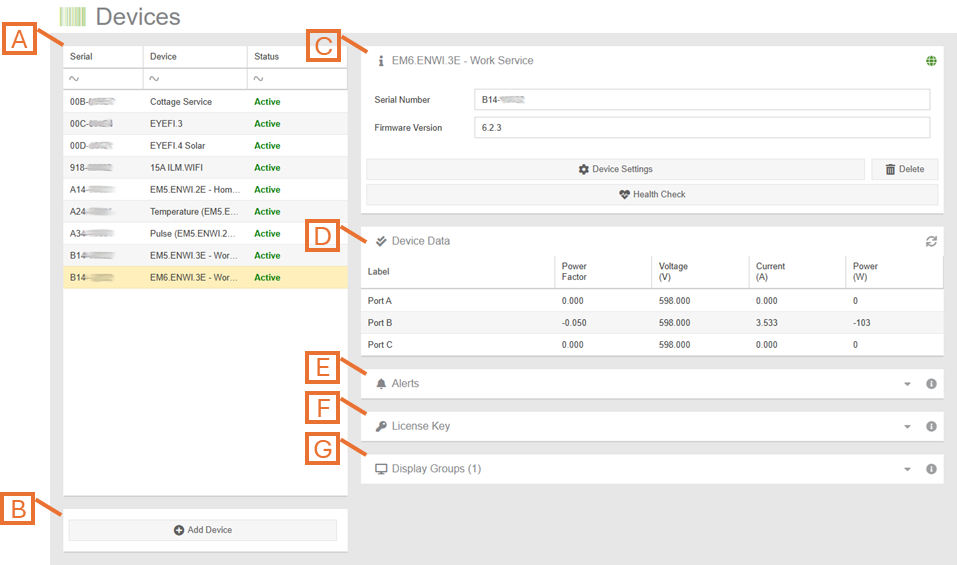
- Device List. Displays a list of all device that you have added to your MyEyedro account.
- NOTE: Only devices you own are shown.
- IMPORTANT: The status column indicates if the device is currently Active or Inactive. Active indicates that the device is powered up and communicating with the MyEyedro Cloud service. Inactive indicates that there is a problem with the device power or internet connectivity.
- Add Device button. Click this button to add a device to your user account.
- Add Virtual Device button (not shown). Click this button to add a virtual device to your user account. NOTE: This functionality is not available to all users and requires a virtual device license.
- Device Info panel. The contents of this panel change based on the type of device selected and if the Show Advanced Info option is checked or unchecked. See Device Info for details.
- Device Data panel. The most recent measurements reported by the device (updated every few seconds). NOTE: This panel is only visible to devices containing sensors. Data columns are dependent on the device model and type(s) of data.
- Alerts panel. Expand this panel to manage alerts associated with this device.
- License Key panel. Expand this panel to manage device license(s).
- Display Groups panel. Expand this panel to see a listing of all display groups associated with this device. A display group is required to view the data from this device in most of the plugins and tools provided by MyEyedro.
- Assets panel (not shown). Expand this panel to see a listing of all assets associated with this device. Assets are only available as a MyEyedro Pro feature.
Devices Configuration Tools and Options
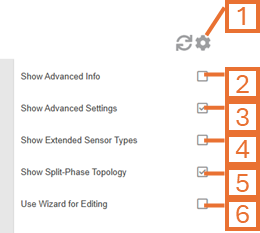
- Plugin Tools:
- Refresh. Update the data and visuals on screen.
- Options. Expand or collapse the options menu.
- Check Show Advanced Info option to display additional advanced information and controls in the Device Info panel.
- Check Show Advanced Settings option to display advanced settings in the device editors (wizard and standard editors).
- Check Show Extended Sensor Types option to display complete list of available sensors in the device editors (wizard and standard editors). By default this option is unchecked to reduce the size of the sensor list to the most commonly used ones. IMPORTANT: If you have purchased a -SUB system and are unable to find the correct sensors in the list, ensure this option is checked. Also note that not all sensor types are supported on all generations of Eyedro devices.
- Check Show Split-Phase Topology option to toggle the diagram used to represent single phase systems, shown on various configuration screens, between a split-phase (two lines with one neutral) and single phase (one line and one neutral). Split-phase systems are common in North American residential installations (i.e. 120V/240V) while single phase is common throughout the world (i.e. 230V).
- Check Use Wizard for Editing option to always use the wizard for device configuration editing. By default, the wizard is only used for configuration during initial device add. It provides additional screens that are helpful in determining that the device is up to date and configured appropriately. On subsequent edits, a more streamlined tab panel is used for editing configuration.
Articles
- Device Installation
- Add Device
- Delete Device
- Device Info
- Edit Device
- Electricity Monitor Settings
- Inline Monitor Settings
- Pulse Monitor Settings
- Temperature Monitor Settings
- Mesh Gateway Settings
- Update Device Firmware
- Health Check
- Device Alerts
- Device License Keys
- Device Display Groups
- Device AssetsPro