
Temperature Monitor Settings | MyEyedro User Guide
To edit a the settings for a Temperature Monitor, navigate to the Devices Configuration plugin and choose the desired device from the list. A device type specific editor will open.
NOTE: Some settings and pages below, denoted by “(advanced)“, are only visible with the Show Advanced Settings options checked in the plugin options.
Advanced Settings
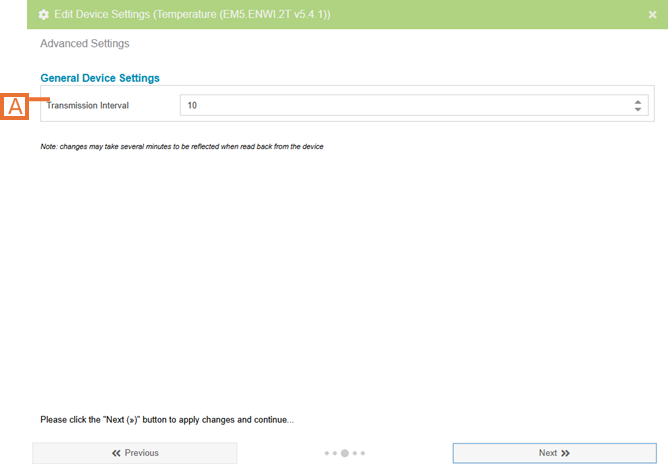
- Transmission Interval. The period, in seconds, over which the temperature measurements will be averaged and a new data point will be captured.
Sensor Calibration
Sensor calibration is used to trim the temperature measurements to improve accuracy. The calibration functionality is also available at a future time directly from the Device Info panel.
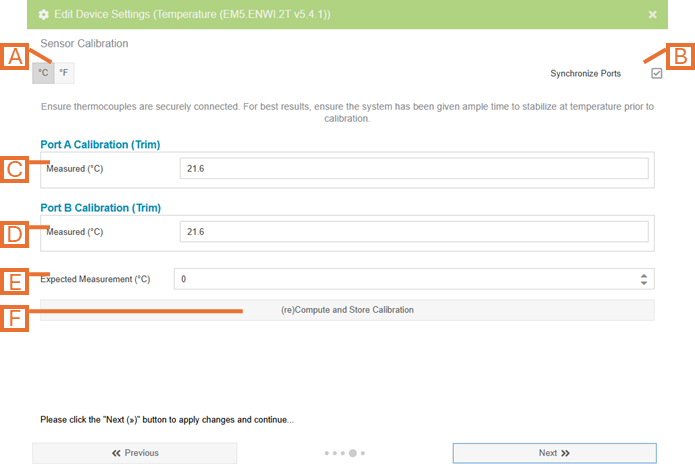
- Choose the desired temperature units.
- If both sensor ports are being calibrated (i.e. using the same ice bath or hot plate), check the Synchronize Ports option.
- Measured value for Port A is displayed. NOTE: value is read only.
- Measured value for Port B is displayed. NOTE: value is read only.
- Using a third party measuring device, enter the expected measurement value.
- Click the Compute and Store Calibration button to compute and store the trim values for ports A and B.
IMPORTANT: Ensure the thermocouples are securely connected to the temperature monitoring device and the device is powered on actively communicating to the internet. The device and connected thermocouples should be given time to stabilize temperature prior to calibration.
Legacy Device Settings
Some older generations of Eyedro hardware (e.g. EBEM1-TM, EBWXS3-TM) do not support the most recent features and functions available in the hardware and software. However, these devices can still be accessed and configured using the “old” setup screen(s).
As with all electronic products, emerging technologies, part(s) and technology obsolescence and general electronics life span issues are things that affect all of us (when is the last time you upgraded your phone or Wi-Fi router?). It is recommended to update any legacy devices in use.
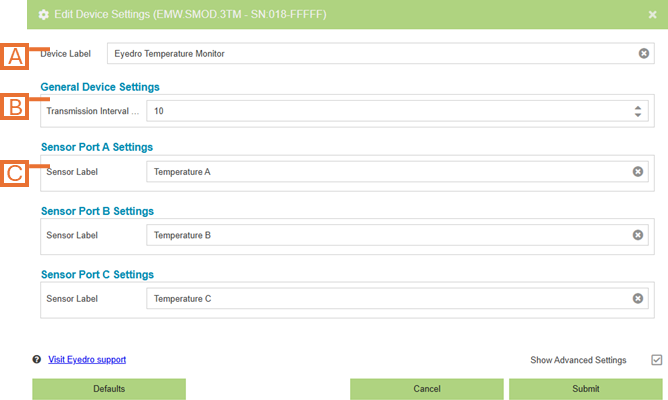
- Device Label. Label should be unique and descriptive for easy identification.
- Transmission Interval (advanced). The period, in seconds, over which the pulses will be counted and a new data point will be captured.
- Sensor Label. A user defined label for identifying this sensor.